The Myth Worth Killing First
"Self-hosting is free after the initial setup." It's one of the most common claims in AI infrastructure conversations, and it's wrong in a way that costs teams real money. Model weights being free to download has nothing to do with what it costs to run them in production. The setup is the smallest part of the bill. What follows is the honest breakdown — compute, maintenance, engineering time, and the hidden costs that rarely make it into the pitch for going self-hosted.
What the API Side Actually Costs
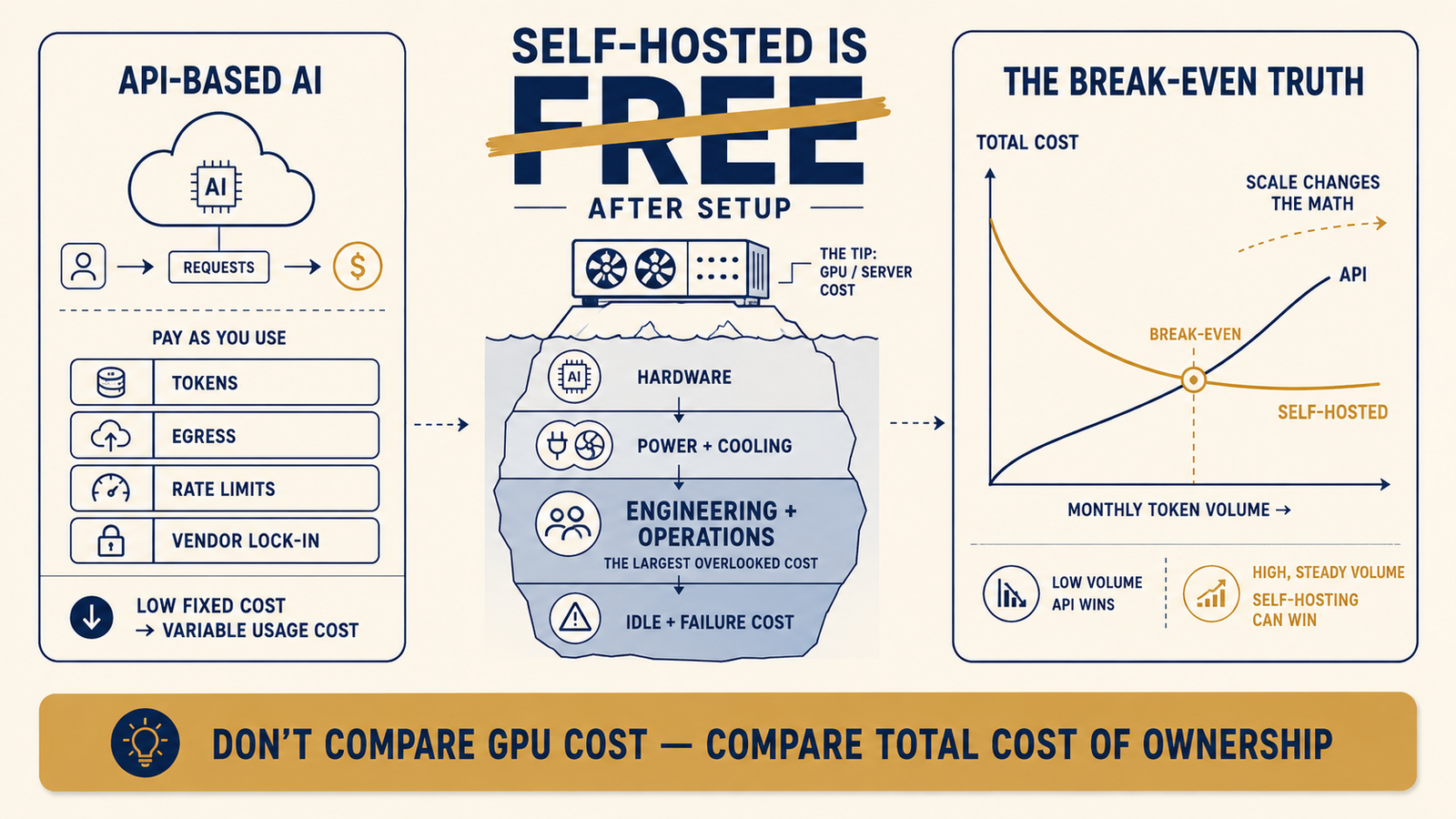
API pricing looks simple: pay per token, nothing to manage. But at real production volume, a few costs creep in that aren't on the price page. Rate limits force you to build queuing, retry logic, and fallback handling once you hit throughput caps — that's engineering time, not just infrastructure cost. High-volume applications also pay data egress fees just to move data to and from the provider. And the more your application is built around a specific provider's response formats, tool-calling conventions, or prompt structure, the more expensive it becomes to ever leave — vendor lock-in is a cost too, it just shows up later, as a switching cost instead of a monthly bill.
What Self-Hosting Actually Costs
Self-hosting has four cost categories, and engineering time is consistently the largest one — usually larger than the hardware itself.
Hardware and compute. Whether you're renting GPU instances, running dedicated servers, or provisioning colocated hardware, this is the visible cost — and the one everyone budgets for. It's also the smallest surprise on the list.
Power and infrastructure overhead. High-end GPUs draw significant power, and cooling typically adds another 25–40% on top of that. If you're pulling data out through a cloud provider, egress fees for high-volume inference output can run into the thousands per month on their own.
Engineering and operations time. This is the line item most comparisons quietly leave out, and it's the one that decides whether self-hosting actually pays off. Standing up inference servers, containerizing and orchestrating them, building auto-scaling and load balancing, and then keeping all of it patched and monitored is not a one-time task — it's ongoing headcount. Realistic budgeting puts this at half to a full-time infrastructure engineer, which in fully loaded cost terms is not a small number. Teams that go in without this expertise often lose more in wasted compute and debugging time in the first few months than they would have spent on a full year of API calls.
Failure and idle cost. Infrastructure has to be provisioned for peak load, which means it sits idle — and costs money — the rest of the time. APIs only bill for what you actually use. Self-hosted systems also carry the cost of downtime, failed experiments, and the ongoing work of tracking new model releases and deciding whether to migrate. None of that shows up in a hardware quote.
So Where's the Break-Even Point?
This is the number that actually matters, and it depends entirely on volume. Below roughly a few million tokens a day, cloud APIs are consistently cheaper once engineering time is factored in — the flexibility and zero operational overhead outweigh the per-token savings of owning your own infrastructure. As usage climbs into the hundreds of millions of tokens a month, the math starts to flip, and self-hosting can undercut API costs meaningfully — some analyses put the savings at 60–80% per token once you're solidly past that threshold. But that saving only materializes at scale, with steady, predictable usage, and with a team that can actually operate what you've built. Below that line, self-hosting isn't a discount — it's a fixed cost you're paying regardless of whether you use it.
Where the "Free After Setup" Myth Breaks Down
The claim usually comes from looking at hardware cost alone and comparing it to a per-token API bill. But model weights and hardware are a fraction of total deployment cost — most of the real spend is in the ongoing labor: deployment, scaling, security patching, monitoring, and the ordinary work of keeping a production system healthy month after month. Teams that skip this in their planning tend to underestimate real self-hosting costs by half or more, and find out the gap the hard way, mid-project.
The Honest Framework
Run this as a real calculation, not a gut check, before committing budget to either path:
1. Estimate your actual monthly token volume — not pilot-stage volume, your expected volume six to twelve months out.
2. Price the API side properly, including rate-limit workarounds, egress, and the switching cost of any vendor-specific integration you'd build.
3. Price the self-hosted side properly, including hardware, power and cooling, and a realistic fraction of an engineer's time — not just the GPU rental rate.
4. Compare at your real volume, not a hypothetical one. The break-even point moves a lot depending on whether you're processing thousands or hundreds of millions of tokens a month.
5. Weigh what volume alone can't capture — data sensitivity, latency needs, and whether your team can actually operate infrastructure long-term, not just stand it up once.
If you're below scale and don't have infrastructure engineering capacity in-house, an API is almost always the cheaper and lower-risk choice today — full stop. If you're well past that volume threshold, handling regulated or sensitive data, or building something where the model itself is a core product differentiator, the self-hosted math starts to make real sense — provided you budget honestly for the team required to run it.
How We Approach This at Rakri AI
We don't sell self-hosting as a default, and we don't sell it as a discount. When we scope a private or self-hosted deployment, the engineering time to operate it long-term is part of the conversation from day one — not a surprise six months in. We've built systems on both sides of this line: fully self-hosted infrastructure provisioned as code for clients with real volume and real compliance requirements, and lighter API-based integrations where that was clearly the faster, cheaper, more honest path. The right answer depends on your numbers, not a philosophy about ownership.
Run Your Own Numbers
The break-even point isn't a fixed rule — it's a calculation specific to your workload, your data sensitivity, and what your team can operate. Anyone recommending self-hosting without asking about your token volume and engineering capacity first is skipping the part of the analysis that actually determines the answer.