The Word "Automation" Covers Two Very Different Things
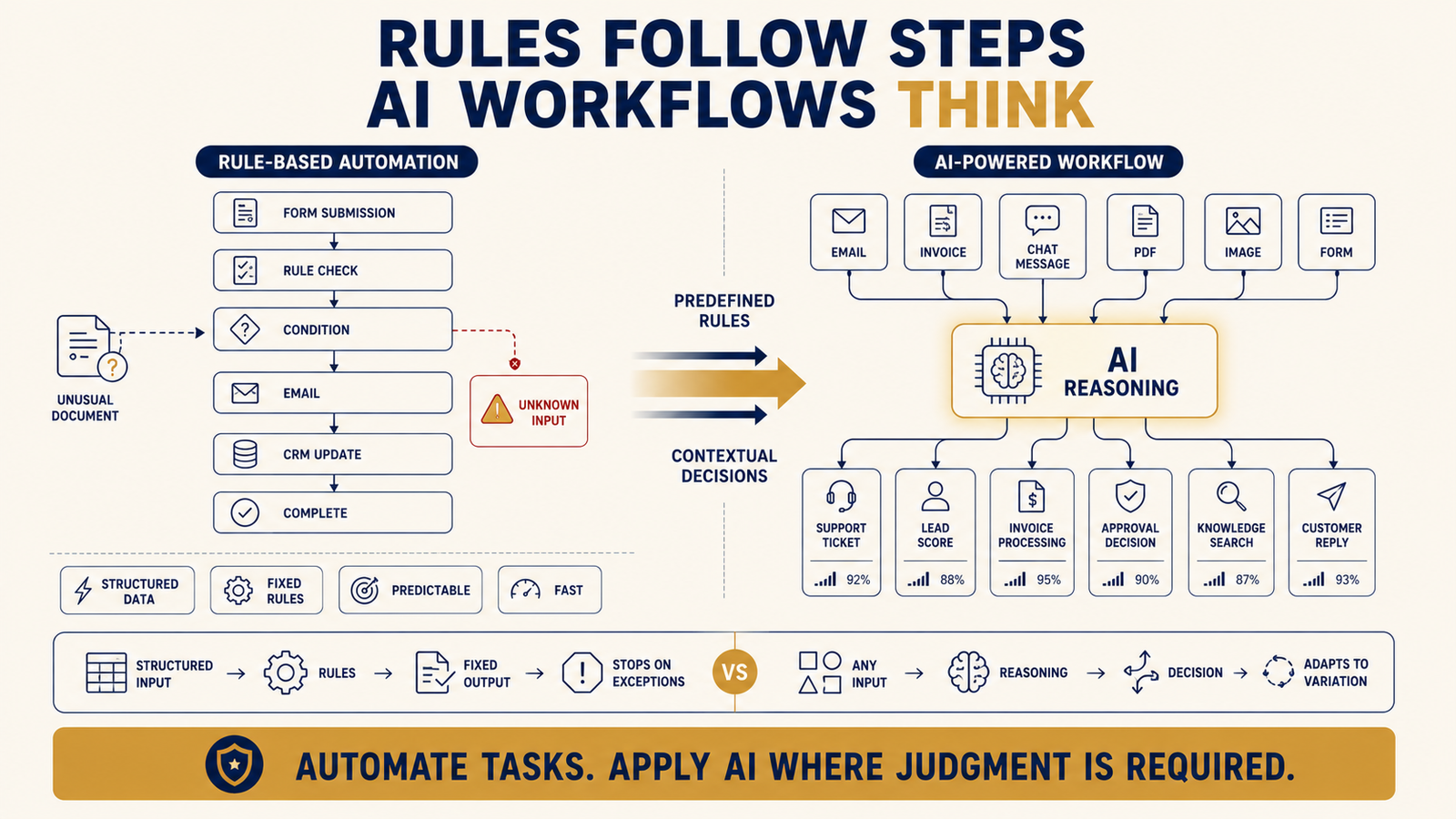
When a business says "we want to automate this process," they're usually pointing at the outcome — less manual work, fewer errors, faster turnaround. What they're not always thinking about is that "automation" is actually two very different technical approaches wearing the same word. One follows rules a human wrote down in advance and executes them exactly, every time, no exceptions. The other reasons about the situation in front of it and decides what to do. Zapier, Make, and traditional RPA tools are the first kind. AI-powered workflows are the second. Knowing which one your process actually needs — not which one is easier to set up this week — is the difference between automation that holds up and automation that quietly breaks in three months.
What Rule-Based Automation Is Actually Good At
It's worth saying plainly: rule-based tools aren't a lesser technology, they're the right technology for a specific kind of problem. If a process is structured, repetitive, and doesn't change — move data from field A to field B, trigger an email when a form is submitted, copy a row from one spreadsheet to another — a rule-based tool does it fast, cheap, and reliably. It requires no reasoning because there's nothing to reason about; every input looks the same and every output should too. This is where Zapier-style tools and traditional RPA genuinely earn their reputation, and dismissing them as obsolete misses where the real ceiling actually is.
Where the Ceiling Actually Is
The ceiling isn't about volume or speed — rule-based tools handle both of those well. It's about anything that requires judgment. Rule-based automation makes no decisions; it simply executes predefined conditions, and the moment reality deviates from what was mapped out in advance, the workflow doesn't adapt — it stops. A few concrete patterns show up constantly:
Unstructured input. A rule-based workflow can route an email based on its subject line matching a keyword. It can't read the email, understand what the customer is actually asking for, and route it based on intent. The moment the input is a document, a free-text field, an image, or a conversation instead of a clean structured record, rule-based tools are working blind.
Anything that changes underneath it. If a vendor updates their portal's layout, moves a button, or changes a field name, an RPA bot built against the old version doesn't adapt — it breaks, silently or loudly, and stays broken until someone rebuilds the instruction set by hand. Rule-based systems are precise about exactly what they were told and brittle about everything else.
Exceptions and edge cases. Every real business process has a long tail of situations nobody wrote a rule for — the invoice that's slightly outside the normal format, the request that doesn't fit any of the predefined categories. A rule-based tool either halts and waits for a human, or worse, forces the exception through a rule that wasn't built for it and produces a quietly wrong result.
Decisions that require weighing context. Approving a loan, scoring a lead, prioritizing a support ticket — these aren't lookups against a fixed condition. They require synthesizing several pieces of imperfect information and reaching a judgment call, which is exactly the category of task rule-based logic was never designed to do.
What Changes With AI-Powered Workflows
An AI-powered workflow doesn't replace the rule-based tool's job — it replaces the assumption that every step in a process can be reduced to a rule someone wrote in advance. Instead of executing a fixed instruction, the system reasons through the input, adapts to variation, and makes a judgment call within boundaries it's been given. That's the practical distinction: rule-based automation asks "does this match the condition I was told to check for," while AI-powered automation asks "given what's actually in front of me, what's the right next step." The second question is the one real business processes are usually actually asking — it's just been forced into the first shape because that was what the tooling could handle.
Concretely, this looks like a document-processing pipeline that can extract meaning from a scanned invoice regardless of its layout, instead of one that only works if every invoice arrives in an identical template. It looks like a lead-qualification workflow that reads the actual content of an inbound message and scores intent, instead of one that only fires off a rule when specific keywords happen to match. It looks like a support-routing system that understands what a customer is actually asking for, even phrased in a way nobody anticipated, instead of a decision tree that dead-ends the moment the conversation doesn't match a predefined branch.
The Honest Trade-off
None of this makes AI-powered automation strictly "better" — it makes it a different tool for a different category of problem, and it comes with real trade-offs rule-based automation doesn't have. It's more expensive to build and run per task. It requires more thoughtful design around what happens when the system is uncertain, because unlike a rule-based bot that fails loudly and stops, a poorly built AI workflow can fail quietly and keep going, producing a plausible-looking wrong answer instead of an error message. And it needs real evaluation and monitoring in a way "if this, then that" logic simply doesn't — you have to actually check whether the judgment calls it's making are good ones, on an ongoing basis, not just whether the pipeline ran.
The right posture isn't "replace all rule-based automation with AI." It's matching each part of a process to the tool that actually fits it. Most real-world workflows aren't purely one or the other — they're a chain of steps where some genuinely are lookups and conditionals, and others genuinely require judgment. The strongest systems put rule-based automation to work handling the structured, repetitive execution it's good at, while an AI layer handles the specific steps — reading unstructured input, exercising judgment, adapting to something that doesn't match the expected pattern — that rules were never built to do.
How to Tell Which One You Actually Need
Before building anything, it's worth asking a short set of questions about the specific process, not the department it lives in:
- Does the input ever arrive in a format, wording, or structure you didn't predict in advance? If yes, that step needs reasoning, not a rule.
- Does the process ever require weighing several pieces of context to reach a judgment, rather than checking a fixed condition? If yes, same answer.
- Has this workflow broken before because something upstream changed — a UI, a field name, a document format? That's a sign the rule-based version is already at its ceiling.
- Is the task genuinely repetitive with no real variation, just at high volume? That's exactly where rule-based automation is still the right, cheaper choice — don't reach for AI just because it's available.
How We Approach This at Rakri AI
We don't start with a tool preference. We start by mapping where a client's process actually needs judgment versus where it's genuinely just repetitive execution, and we build accordingly — sometimes that means a straightforward workflow automation layer, sometimes it means an AI system doing the reasoning, and often it means both working together, with the AI handling the parts a rule-based tool would quietly get wrong. If a process is breaking today, the fix usually isn't more rules bolted onto the existing ones — it's recognizing that the step that keeps breaking was never a rule-following problem to begin with.