The Pattern Most Teams Discover Too Late
The first AI feature is usually the easy one. A team stands up an integration, wires it into one product, ships it, and moves on. The trouble starts with the second product. Instead of extending what already exists, the natural instinct is to build another isolated integration from scratch — its own AI service connections, its own data pipeline, its own security review, its own infrastructure. By the third or fourth product, the organization isn't running an AI strategy anymore. It's running several unrelated AI projects that happen to share a company name, each with its own maintenance burden and its own way of doing things.
Why Isolated Integrations Don't Scale
Building AI per-product feels safe because it keeps each integration simple and contained. But the cost shows up later, and it shows up in a few predictable places. Every isolated integration means duplicated infrastructure — separate compute, separate monitoring, separate deployment pipelines for functionally the same underlying capability. It means duplicated security review, because each integration has to be independently audited rather than inheriting a foundation that's already been assessed. And for a company operating under strict data-handling expectations, it means duplicated risk: infrastructure stood up ad hoc, product by product, isn't auditable or reproducible in any consistent way, because there's no single foundation to point to when a compliance question comes up. What starts as "keep it simple per product" ends up as the opposite — a sprawl of AI systems that are each individually simple but collectively unmanageable.
The Shared Foundation Alternative
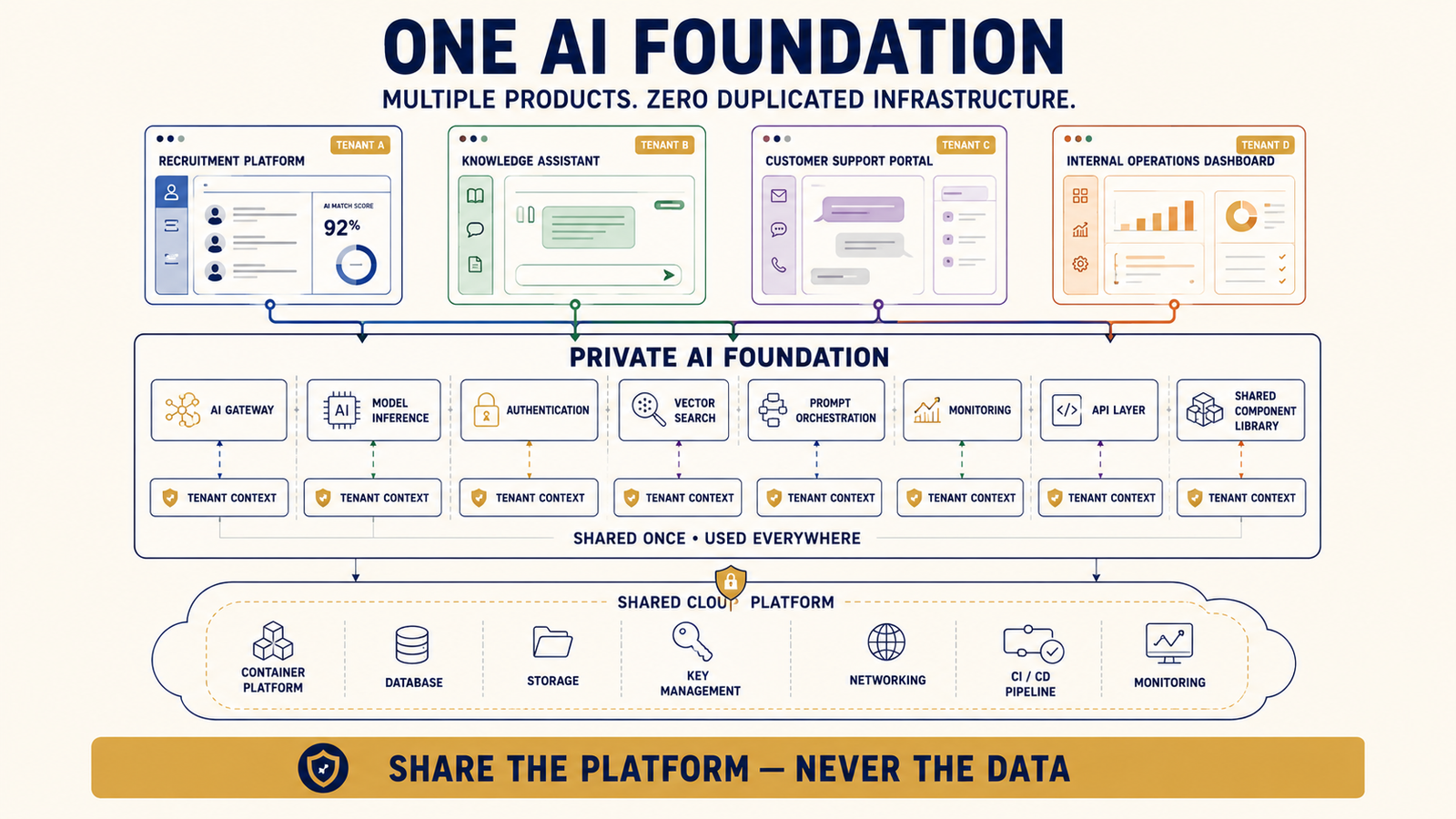
The alternative is to treat private AI infrastructure as a foundation other products get built on top of, not a feature bolted onto each product individually. Concretely, that means a shared architecture — model access, retrieval infrastructure, authentication, monitoring, and the underlying cloud footprint — that every product line draws from, with each product remaining independently scalable and each tenant's data cleanly isolated. This is the same principle behind any well-built multi-tenant SaaS platform: a single, shared instance serving multiple customers or, in this case, multiple products, with strict boundaries enforced between them so that no product or tenant can see another's data. The infrastructure is shared. The isolation is not negotiable.
What Actually Has to Be Shared vs. Isolated
This is where teams get the split wrong most often — either sharing too much and creating cross-tenant risk, or isolating too much and recreating the original sprawl problem under a different name.
What belongs in the shared foundation: the underlying cloud infrastructure and provisioning pipeline, model access and inference layers, core authentication and identity handling, observability and monitoring, and the CI/CD process that deploys everything. These are functionally identical across products — there's no good reason for four products to each maintain their own version of the same deployment pipeline.
What must stay strictly isolated per tenant, even on shared infrastructure: the actual data. This is non-negotiable, and current best practice is explicit about it — tenant context and access controls need to be enforced at every layer that touches shared infrastructure, not just the primary database. A tenant ID sitting in a database column is not tenant isolation; it's a single point of failure away from being one. Real isolation happens through consistent enforcement across data access, background jobs, and queues alike — every job payload, every worker process, every session needs to carry and re-verify tenant context, because the moment one layer assumes "this is internal, so it's already been checked," that's the layer where a boundary quietly breaks.
Why This Pays Off Structurally, Not Just Financially
The obvious benefit of a shared foundation is cost — infrastructure gets used once across products instead of duplicated per product, and security patches or compliance updates get applied centrally instead of four separate times. But the more important benefit is structural. When a new product needs an AI capability, the question stops being "how do we build AI infrastructure for this" and becomes "how do we extend the foundation we already have." That changes both the timeline and the risk profile of every product launch after the first. It also means the organization only has to get infrastructure provisioning, security review, and compliance posture right once — deeply — rather than adequately, four separate times.
Where This Breaks If Done Carelessly
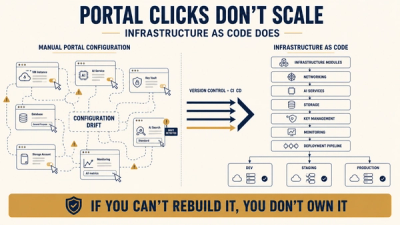
None of this works if the shared foundation becomes a shared liability instead of a shared asset. If tenant isolation is treated as an afterthought bolted onto a shared database, a bug in one product's AI feature can leak into another tenant's data — and because everything is now interconnected, the blast radius of a mistake is larger than it would have been with fully isolated systems. The organizations that get this right build tenant awareness into the foundation from day one — provisioned as code, with isolation enforced at the infrastructure level rather than trusted to application logic alone — rather than retrofitting it after the third product has already shipped without it.
How We Approach This at Rakri AI
This is the exact pattern behind the private AI infrastructure we built for Mijn AI Omgeving. Rather than standing up a separate AI integration for each of their product lines, we designed a shared foundation: four independently-scalable applications in a single monorepo with a shared component library and domain-level multi-tenancy, running on infrastructure provisioned entirely as code — container orchestration, search, databases, key management, and storage — deployed through the same CI/CD pipeline across every environment. Two flagship products run on top of that foundation today, each fully isolated from the other's data, both benefiting from infrastructure that only had to be built, secured, and audited once.
Build the Foundation Before You Need the Fourth Product
The mistake is rarely visible at the first product. It becomes visible at the third or fourth, when a team realizes they're maintaining four versions of something that should have been one. If your roadmap includes more than one AI-powered product, the infrastructure decision that matters most isn't which model to use — it's whether you're building a foundation or a pile of one-off integrations that happen to share a login page.