The Question Every Team Gets Wrong
Most teams start this conversation from the wrong end. They ask "should we self-host our AI?" before they've asked what problem they're actually solving. The honest answer is that none of the three options — on-premise, private cloud, or public API — is universally better. Each one trades cost, speed, and control differently, and the right choice depends on your data, your scale, and what your team can realistically operate. This is a framework for making that call deliberately instead of by instinct.
What Each Option Actually Means
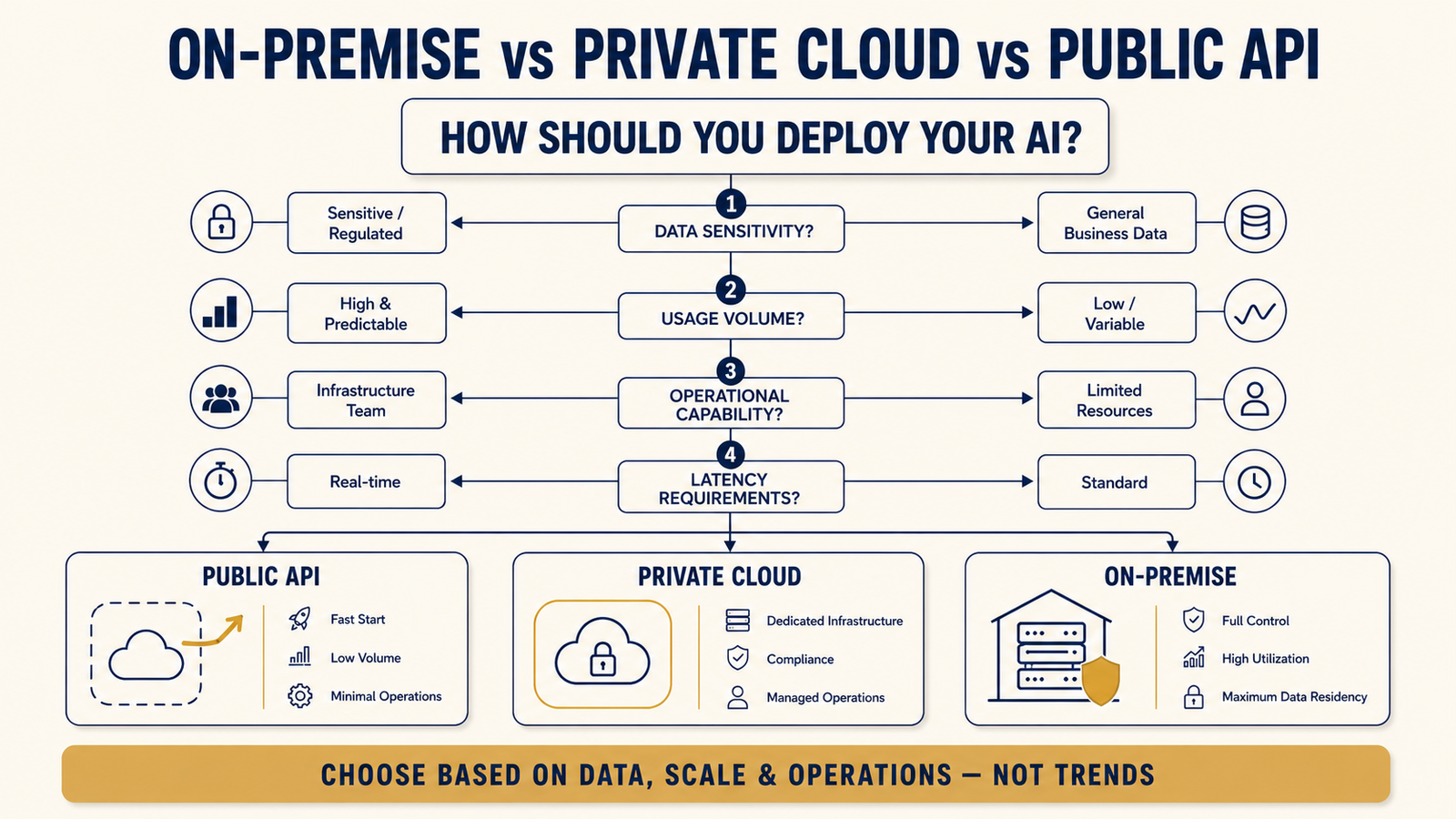
It helps to be precise about the terms, because they get blurred constantly. On-premise means the model runs on hardware your organization physically owns, usually in your own data center or a colocation facility. Private cloud means dedicated infrastructure managed by a cloud provider on your behalf — your data still transits their network, but the compute isn't shared with other tenants. A public API means you send requests to a third-party model provider and get responses back, with no infrastructure to manage at all. The distinction between on-premise and private cloud in particular is one of the most misunderstood areas in AI deployment, and conflating the two leads teams to underestimate what "private" really costs.
Start With Data Sensitivity, Not Cost
Before anything else, ask what the AI system will actually touch. If it's processing customer PII, financial records, health data, or anything under GDPR, HIPAA, or similar regulation, that alone narrows the field. Public APIs mean your data leaves your perimeter and crosses jurisdictional boundaries, which is a legitimate blocker for regulated industries regardless of what a vendor's compliance page promises. On-premise and private cloud deployments keep the data — and the inference process itself — inside a boundary you control and can audit. If your workload involves agentic systems making repeated calls across internal databases and APIs, this matters even more: every one of those calls in a public cloud environment can become a data residency event, while in a self-hosted setup the entire execution loop stays inside your own security boundary.
Then Look at Real Usage Volume
Cost is where most self-hosting decisions actually get made, and it's also where teams do the worst math. Public APIs are cheap and fast to start because there's no capital outlay — you pay per token and scale up or down instantly. That makes them the right call for prototyping, pilots, and workloads with unpredictable or bursty demand. But at steady, high-volume usage, the economics flip. Industry cost modeling in 2026 shows on-premise inference can run several times cheaper per million tokens than cloud API pricing once utilization is consistently high, because you're no longer paying a per-request margin on top of compute you could own outright. The mistake teams make is estimating this at pilot-stage volume and assuming the ratio holds — it doesn't. Run the math at your actual expected 12-month volume, not this month's.
Factor In What Your Team Can Actually Operate
This is the factor that gets skipped most often. Self-hosting an LLM isn't just standing up a GPU box — it's ongoing patching, model updates, scaling under load, monitoring, and incident response, indefinitely. A private, self-hosted system that nobody on your team can maintain becomes a liability faster than a public API ever will. If you don't have infrastructure engineers who can own this, either a public API or a managed private cloud deployment — where a provider operates the hardware on your behalf — is the more honest choice, even if it costs more per unit. Ownership only pays off if you can actually run what you own.
Latency and Where Your Users Are
If your AI system sits inside a live operational workflow — approvals, fraud checks, real-time recommendations — network hops to a public API add delay that compounds at scale. On-premise deployments, by keeping inference physically close to where the data and users already are, tend to reduce this significantly. For global user bases, this cuts the other way: a single on-premise deployment can't be everywhere at once, and a globally distributed cloud footprint may actually serve users faster. Map your latency requirements to where your users and data actually sit before assuming either extreme is the answer.
The Simple Framework
Once you've weighed those four factors, most decisions sort into one of three buckets:
Public API fits when: you're prototyping or piloting, usage is unpredictable or low-volume, the data isn't sensitive or regulated, and you don't have infrastructure headcount to dedicate to this.
Private cloud fits when: you need data control and auditability, but you don't want to own and operate physical hardware — someone else runs the infrastructure, on dedicated resources, under contract terms you can point to in a compliance review.
On-premise fits when: usage is high and steady enough that the unit economics clearly favor ownership, the data is sensitive enough that it can't leave your perimeter under any circumstances, and you have — or are willing to build — the team to run it long-term.
Why Most Real Deployments Are Hybrid
In practice, few organizations land cleanly in one bucket for everything. The more common pattern is workload-by-workload: sensitive, steady-state processing stays on-premise or in a private cloud, while bursty or exploratory workloads run against a public API. Industry analysts project that a large majority of enterprises will run hybrid deployment models by 2027, splitting workloads across all three environments rather than standardizing on one. The hard part isn't choosing a side — it's operating consistently across more than one environment without losing track of where each workload's data actually lives.
How We Approach This at Rakri AI
We don't walk into a deployment conversation with a predetermined answer. We've built systems across all three models — fully self-hosted infrastructure provisioned as code for clients who needed complete data control, and lighter integrations where a public API was clearly the faster, cheaper path to a working system. The starting point is always the same: what does the data require, what does the volume justify, and what can the team actually operate after we hand it off. If self-hosting isn't the right call for your situation, we'll say so before we build anything.
A Framework, Not a Rule
There's no version of this decision that's right for every business, and treating "self-hosted" or "cloud-first" as a permanent identity instead of a per-workload decision is how teams end up overpaying or overexposing themselves. Revisit the call as your usage volume, regulatory environment, or team capacity changes — the right answer at pilot stage is often not the right answer a year into production.